By AlineMyer.com — April 27, 2026

Photo: Unsplash — Luxury timepiece
Table of Contents
- Overview
- The U.S. Luxury Goods Market Boom
- Luxury Watches: A $60 Billion Global Force
- Christie’s Auctions: Watches & Handbags Lead Secondary Market
- The Resale & Pre-Owned Surge
- Who Is Buying: Millennials, Gen Z & Women
- Outlook for 2026
- Sources
Overview
Despite global macroeconomic headwinds, the U.S. luxury goods sector — anchored by high-end watches and designer handbags — is on a powerful long-term growth trajectory. New data from multiple industry sources confirms that the American market is expanding rapidly, auction houses are posting record results in watches and handbags, and a new generation of buyers is reshaping who purchases luxury and how.
The U.S. Luxury Goods Market Boom
The United States luxury goods market is projected to grow from $115.22 billion in 2024 to $196.16 billion by 2033, at a compound annual growth rate (CAGR) of 6.09%. Key growth drivers include rising disposable incomes, surging demand from Millennials and Gen Z, the expansion of e-commerce and omnichannel retail, and the influence of celebrity and influencer endorsements. States leading the charge include California, New York, Texas, and Florida. $CITE_1
Major luxury conglomerates — including LVMH, Gucci parent Kering, and Prada — are doubling down on the U.S. market with flagship boutiques, digital investments, and sustainability initiatives. In February 2025, Ray-Ban appointed ASAP Rocky as its first global creative director, signaling how luxury brands are now prioritizing cultural relevance over traditional design credentials to capture younger American consumers. $CITE_1
Luxury Watches: A $60 Billion Global Force
The global luxury watch market was valued at $53.69 billion in 2024 and is projected to reach $59.97 billion in 2025, eventually hitting $134.53 billion by 2032 at a CAGR of 12.23%. The U.S. market alone is expected to reach $19.14 billion by 2032. $CITE_3
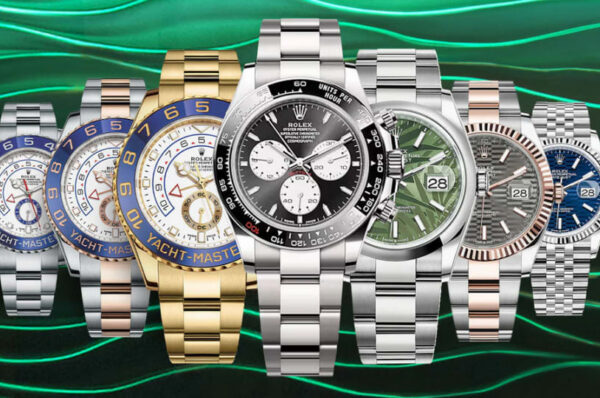
Mechanical watches from heritage Swiss brands — Rolex, Patek Philippe, and Audemars Piguet — continue to dominate consumer preference, driven by their association with craftsmanship, status, and collectibility. The growing perception of luxury watches as investment-grade assets is a key accelerator of U.S. demand. $CITE_3
Christie’s Auctions: Watches & Handbags Lead Secondary Market
Christie’s 2025 annual results delivered a landmark moment for the secondary luxury market. The auction house posted over $1 billion in global luxury sales (excluding private sales), with its luxury segment recording a 90% sell-through rate and 129% of lots selling above their low estimates. Watches alone generated $162.5 million in global auction sales, with 81% of lots selling within or above estimate. $CITE_4
Handbags, jewelry, and watches were identified as the top-performing categories, benefiting from broad cultural familiarity and wide price accessibility. Christie’s Global Managing Director of Luxury, Kimberly Miller, noted: “Categories such as jewelry, watches, wine and handbags benefit from broad cultural familiarity and span a wide range of price points, making them appealing for first-time bidders and buyers.” $CITE_4
The Resale & Pre-Owned Surge
The secondhand luxury goods market grew to an estimated €50 billion globally in 2025, with sales rising 4%–6% year over year. Consumers are increasingly drawn to pre-owned watches and handbags for their value retention, rarity, and sustainability credentials. $CITE_2
Bain & Company’s 24th Annual Luxury Study confirmed that while the broader personal luxury goods market saw a mild 2% erosion — falling from €364 billion in 2024 to €358 billion in 2025 — the pre-owned and accessible luxury segments showed renewed vitality, with approximately 50% of accessible luxury brands growing in 2025. $CITE_2
Who Is Buying: Millennials, Gen Z & Women
A generational and demographic shift is redefining the luxury buyer. At Christie’s, 44% of participants in 2025 were Millennials and Gen Z, and 85% of bids were placed online. These cohorts are digitally native, brand-conscious, and increasingly treating luxury watches and handbags as both personal expression and financial assets. $CITE_4
Women are also emerging as a dominant force. The number of female buyers at Christie’s grew 10% year over year, while total spending from female clients rose 20% year over year across all regions — a trend linked to rising female wealth, generational wealth transfer, and growing financial agency among women entrepreneurs and investors. $CITE_4
On the sustainability front, a Stifel survey found that 20% of Millennials and 22% of Gen Z in the U.S. only purchase from brands that align with their values or practice sustainability — pushing luxury houses to adopt circular economy principles and eco-friendly materials. $CITE_1
Outlook for 2026
The Americas region stabilized in 2025 amid macroeconomic volatility, with local luxury spending strengthened as a weaker dollar encouraged American consumers to shop domestically rather than abroad. This trend is expected to continue into 2026, benefiting U.S.-based luxury retailers. $CITE_2
For watches and handbags specifically, the convergence of auction market momentum, pre-owned market growth, and a digitally engaged younger buyer base positions 2026 as a strong year for U.S. luxury retail. Brands and retailers that invest in digital commerce, provenance storytelling, and sustainability messaging are best placed to capture this demand. $CITE_3 $CITE_4
Sources
- Yahoo Finance / ResearchAndMarkets — U.S. Luxury Goods Market Forecast Report 2025–2033
- Bain & Company — Finding a New Longevity for Luxury (24th Annual Luxury Study, 2025)
- Fortune Business Insights — Luxury Watch Market Size, Share & Trends 2025–2032
- Observer — Luxury Auctions Surged in 2025: Christie’s Watches, Handbags & Jewelry Drive Record Results
© 2026 AlineMyer.com — All rights reserved.